
Breast cancer happens when abnormal cells in the breast grow uncontrollably and form a lump or tumour. These cells can sometimes spread to nearby tissues or other parts of the body if not treated early.
Breast cancer can affect:
The good news is that early detection greatly improves treatment success and survival rates.
Our body naturally creates new cells every day. Sometimes, certain breast cells change or become abnormal due to damage in their DNA. Instead of stopping or dying normally, these abnormal cells continue growing and may form a tumour.
Some tumours are:
Some common risk factors include:
However, many people diagnosed with breast cancer may not have any obvious risk factors.
If you notice any unusual changes, consult a healthcare professional early.
Need help with the cost? Reimbursement for your purchase through selected organisations and support funds is possible. Our team is happy to provide supporting documents to assist you with your reimbursement. Please contact us for consultation.

Breast cancer is the most common cancer among females. In 2017–2021, starting at age 40, a greater incidence rate was observed compared to 2012–2016, particularly in the 65–69 age group. In 2017–2021, the percentage diagnosed at late stages (Stage 3 & 4) was 50.5%.
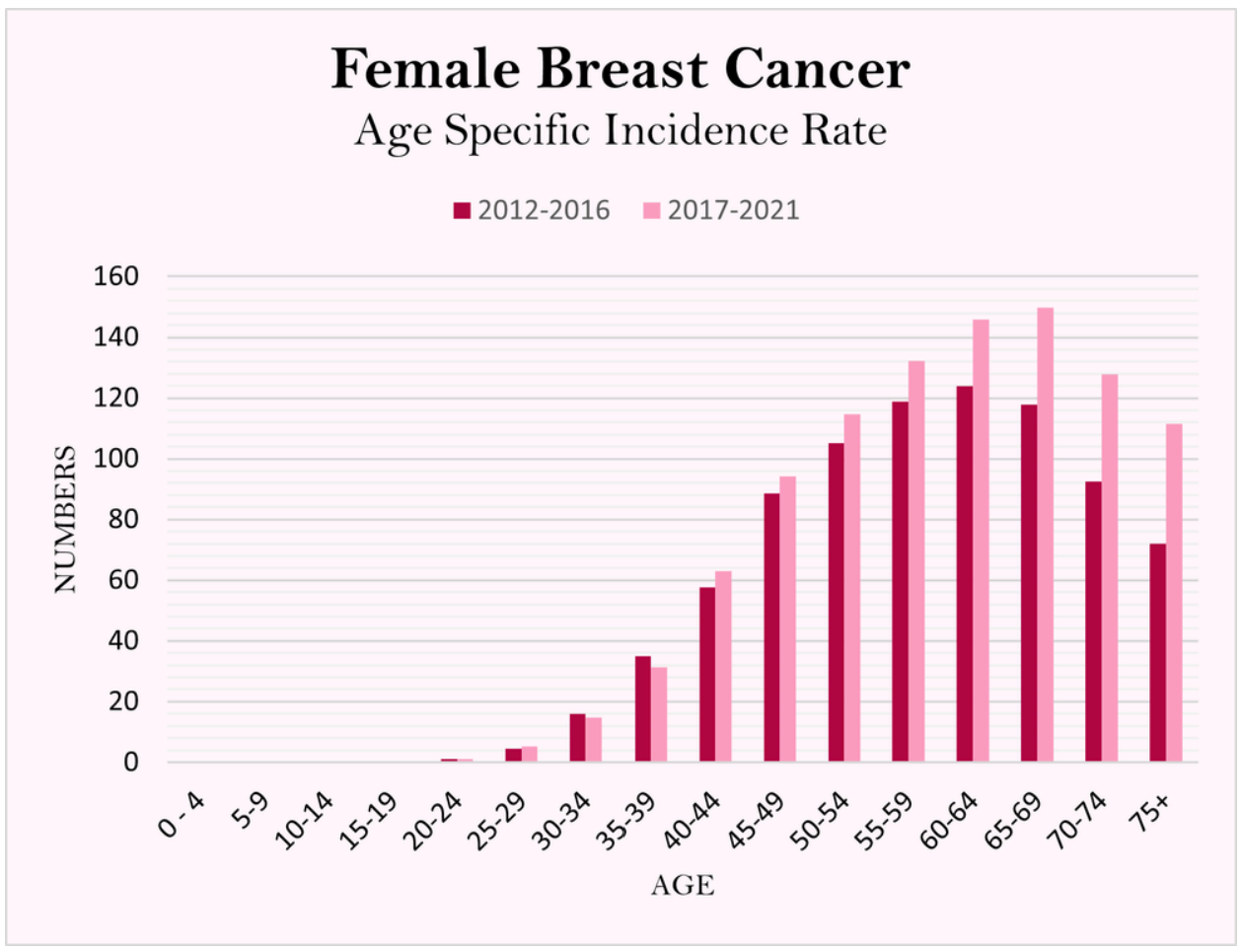
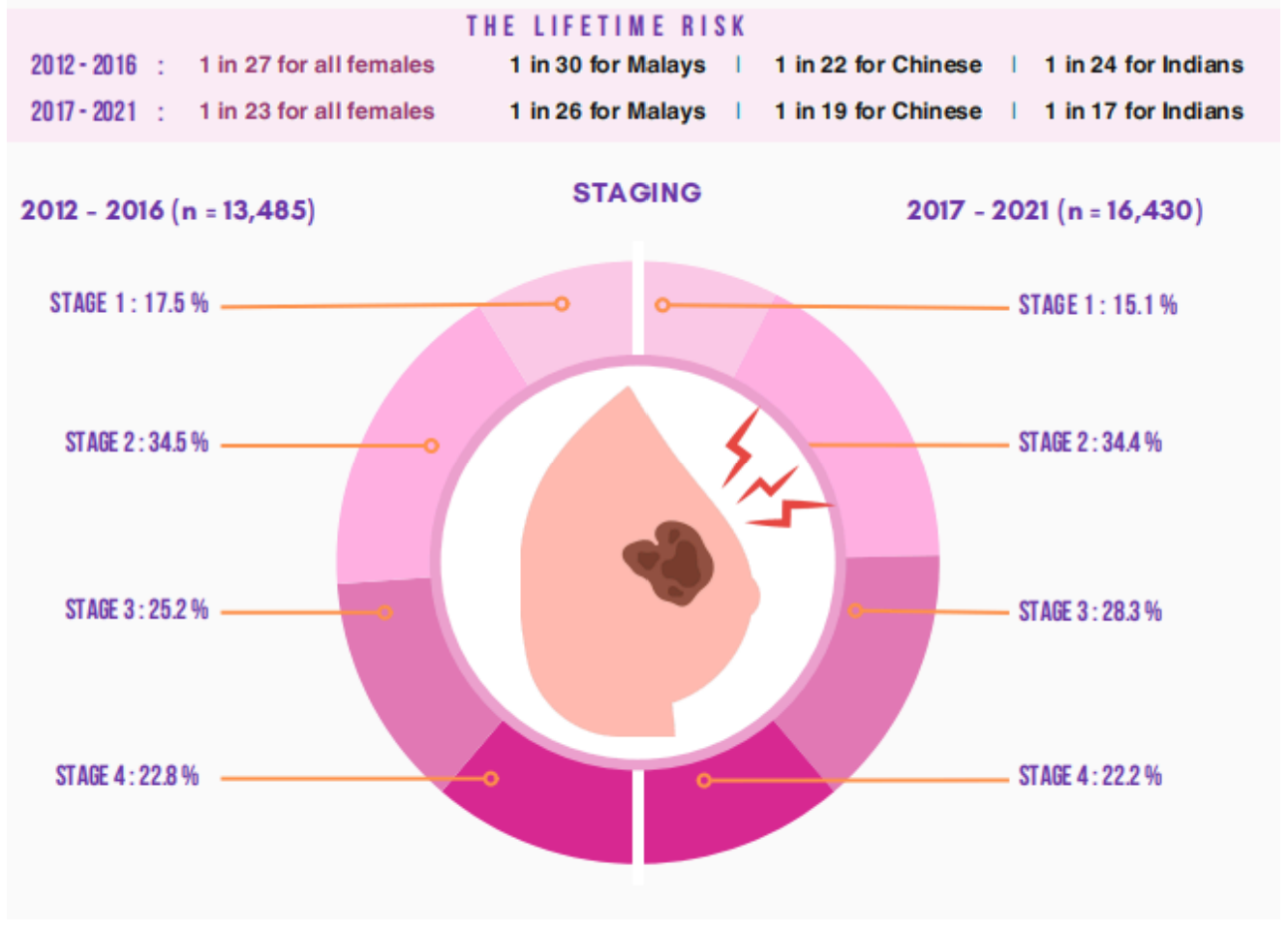
Source: Summary of the Malaysia National Cancer Registry Report 2017–2021 (National Cancer Registry Department, 2024).
Screening refers to checking the breasts for signs of cancer before symptoms appear. The aim is to detect cancer early, when treatment is easier and more effective.
Early-stage breast cancer may not cause symptoms. Screening helps:
Breast Self-Examination (BSE)
Women are encouraged to regularly check their own breasts for lumps, skin changes, and nipple changes.
Clinical Breast Examination (CBE)
A doctor or healthcare professional examines the breasts and underarm areas (including ultrasound).
Mammogram
A low-dose X-ray of the breast used to detect abnormalities that may not be felt physically. Additional imaging may include an MRI scan for selected patients.
Depending on the findings:
It is the process of confirming whether a breast abnormality is cancerous or non-cancerous. This usually involves imaging tests, tissue sampling (biopsy), and laboratory analysis.
Diagnosis is important to:
Imaging Assessment
Doctors may use a mammogram, ultrasound, or MRI to locate and assess suspicious breast lesions.
Breast Biopsy Procedure
A biopsy involves taking a small tissue sample from the suspicious area for laboratory testing.
Patients may then proceed to their treatment.
Treatment aims to remove, destroy, or control cancer cells while helping patients recover and maintain quality of life. Every treatment plan is personalised based on cancer stage, tumour size, overall health, and patient preferences.
Surgery — removing only the tumour (lumpectomy) or the whole breast (mastectomy).
Radiotherapy — uses high-energy radiation to target cancer cells.
Chemotherapy — uses chemical drugs to destroy cancer cells.
Targeted Therapy — specialised drugs target specific parts of cancer cells.
Hormonal Therapy — lowers hormone levels or blocks the fuelling of cancer growth.
Immunotherapy — boosts your immune system to fight cancer.
Before surgery or treatment, some tumours may be very small or difficult to locate. Marking solutions help surgeons accurately identify the targeted area. This improves:
BIP O-Twist Marker®
A breast marker placed after a biopsy to identify the lesion location. Helps track the biopsy site, assists with future imaging and surgery, and supports treatment planning.
BIP Mam-O-Guide® Wire
A preoperative localisation wire used to guide surgeons to non-palpable breast lesions before surgery — secure tissue anchoring, accurate lesion localisation, and improved visibility during procedures.
After treatment, patients continue with follow-up appointments, imaging surveillance, recovery and rehabilitation, and emotional and psychological support. Long-term monitoring is important to ensure continued health and to detect any recurrence early.
| Myths | Facts |
|---|---|
| “Breast cancer only happens to older women.” | Breast cancer can happen at any age. Although the risk increases with age, younger women can also develop breast cancer. |
| “If I have no family history, I won’t get breast cancer.” | Most people diagnosed with breast cancer do not have a family history of the disease. |
| “A breast lump always means cancer.” | Not all breast lumps are cancerous. Many lumps are benign, but any new lump should still be checked by a healthcare professional. |
| “If there is no pain, it is not breast cancer.” | Early breast cancer often does not cause pain. That is why regular screening and breast awareness are important. |
| “Mammograms cause breast cancer because of radiation.” | Mammograms use a very low dose of radiation and are considered safe. The benefits of early detection greatly outweigh the small risk. |
| “Breast cancer can spread after a biopsy.” | Biopsy procedures are safe and do not cause cancer to spread. Biopsies are essential for accurate diagnosis and treatment planning. |
| “Only women can get breast cancer.” | Men can also develop breast cancer, although it is much less common. |
| “Wearing bras causes breast cancer.” | There is no scientific evidence linking bras to breast cancer. |
| “If I live a healthy lifestyle, I will never get breast cancer.” | A healthy lifestyle can reduce risk, but anyone can still develop breast cancer. Regular screening remains important. |
| “Breast cancer always requires removal of the whole breast.” | Some patients may only require removal of the tumour (lumpectomy) depending on the stage and size of the cancer. |
| “Breast cancer means death.” | Many people survive breast cancer, especially when it is detected and treated early. Advances in screening and treatment continue to improve survival rates. |
| “Once treatment ends, follow-up is no longer necessary.” | Regular follow-up appointments are important to monitor recovery, manage side effects, and detect any recurrence early. |
Our team is here to help with information, guidance, and reimbursement support.
Contact Us